Pitt Games Reading Group Archive
an archive of information on previous meetings of the Pitt Games Reading Group
Welcome to the Pitt Games Reading Group archive! Below you will find information on previous meetings of this group. If you’re looking for information on our next meeting or to sign up for our mailing list, please visit the group’s main page).

Previous Meetings (Most Recent First)
Spring 2026 (March)
Meeting Details: March 27th, 2026, 4:00 – 5:30PM, CL 512
Game: Homebody (2023) by Game Grumps, Jory Griffis, and Leighton Gray

Reading: None
Description: For our second revitalized meeting of the Pitt Games Reading Group, we seek new horizons in our conversations about video games following our escape from the Starship Titanic. Unfortunately, we appear to have found ourselves in another kind of puzzle-filled locale, this time trying to navigate our player-character’s relationship to her friends and equally frightening threats to their safety.
For our March 2026 meeting, we will be discussing Homebody (2023), “a time loop horror puzzle game from Game Grumps.” This game offers a contemporary spin on survival horror classics such as Resident Evil* (1996) and Clock Tower (1996), mixing the aesthetics and mechanics of its inspirations with a personal, character-driven focus. The combination of smaller, more immediate puzzles and narrative-driven problems that require thinking across rooms, floors, and time enables a story about social anxieties and complex interpersonal relationships. As a result, Homebody should appeal to fans of thoughtfully written psychological horror, the survival horror genre, and/or the recent resurgence of PSX-influenced horror titles (e.g. Mouthwashing, Signalis, or Crow Country).
Additionally, one of the game’s two co-writers, Leighton Gray, will be virtually calling in to speak to students in one of Dr. Koob’s courses. Her experience as a writer for video games and her work on Homebody in particular will give us insight into the game itself, the process of writing for video games, and working as a writer and creator for video games as part of a development team. Those who attend this PGRG meeting will be invited to attend her virtual visit, where you will have the opportunity to ask her questions!
Discussion Questions:
- How do we come to understand Emily and her relationships to others through the game’s looping narrative structure? What do we learn within each loop, and then what do we learn about Emily across these loops?
- How many puzzles (both within loops and across loops) were you able to solve on your own? Which puzzles had you stuck, or needing to look up solutions online? Did you feel that the puzzles effectively contributed to the game’s narrative and design goals?
- How does Homebody represent topics such as social anxiety, mental health, and interpersonal relationships? How are these topics explored through writing, mechanics, and other elements of design? Are there other contemporary issues you see being explored?
- How does Homebody make you think about identity and how your sense of identity relates to others? How does it make you think about the player character’s identity, or your own?
Fall 2025 (November)
Meeting Details: November 7th, 2025, 3:30 – 5:00PM, CL 407
Game: Starship Titanic (1998) by the Digital Village and Douglas Adams
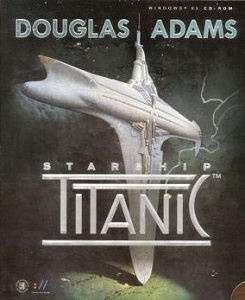
Reading: excerpts from The Salmon of Doubt: Hitchhiking the Galaxy One Last Time by Douglas Adams (pp. 85–121; 155–160)
Description: For our first revitalized meeting of the Pitt Games Reading Group we naturally assumed that nothing could possibly go wrong, hence, our first game is Douglas Adams’ Starship Titanic (1998) “the ship that could not possibly go wrong . . . [and] did not even manage to complete its very first radio message–an SOS–before undergoing a sudden and gratuitous total existence failure”; perhaps this is equally hubristic, but Dr. Eldin and Dr. Koob have nothing but high hopes for this.
Starship Titanic is a unique graphic adventure game that flew under the radar despite its connection to the popular author. Some of you may know Douglas Adams as the writer of the Hitchhiker’s Guide to the Galaxy series across multiple media forms (radio play, novels series, TV miniseries, text adventure game, and Hollywood film) and one of the writers for the original Dr. Who. He was often interested in pointing out the absurdity of bureaucracy and the human need to try and understand things that we simply cannot understand. He was also an avid technology enthusiast and often wrote about the ways in which computers started to enter our daily lives.
This game is a good example of his work and our current societal interests in generative AI in that the developers at The Digital Village created a language processor (SpookiTalk) to allow the player to freewrite conversational dialogue that the robots of the ship respond to with a bank of 16 hours of recorded dialogue (thus, limiting the amount of repeated dialogue).
The game should take around 3 hours to complete and the accompanying readings are short writings by Adams about how we deal with technology as a part of our daily lives. We’re looking forward to seeing you!
Discussion Questions:
- How does the experience of this game connect with your sense of generative AI? Did this feel like talking to a chatbot or an LLM? Did it seem like something subtly or completely different?
- What might Adams be saying here about automation? Travel? Human systems? Do you see any ways in which the critiques we see in his writings correspond to the themes of this game?