Pitt Games Reading Group Archive
an archive of information on previous meetings of the Pitt Games Reading Group
Welcome to the Pitt Games Reading Group archive! Below you will find information on previous meetings of this group. If you’re looking for information on our next meeting or to sign up for our mailing list, please visit the group’s main page).

Previous Meetings (Most Recent First)
Fall 2025 (November)
Meeting Details: November 7th, 2025, 3:30 – 5:00PM, CL 407
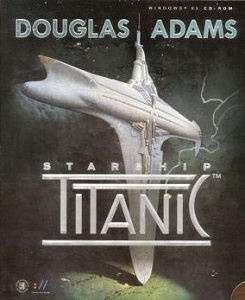
Game: Starship Titanic (1998) by the Digital Village and Douglas Adams
Reading: excerpts from The Salmon of Doubt: Hitchhiking the Galaxy One Last Time by Douglas Adams (pp. 85–121; 155–160)
Description: For our first revitalized meeting of the Pitt Games Reading Group we naturally assumed that nothing could possibly go wrong, hence, our first game is Douglas Adams’ Starship Titanic (1998) “the ship that could not possibly go wrong . . . [and] did not even manage to complete its very first radio message–an SOS–before undergoing a sudden and gratuitous total existence failure”; perhaps this is equally hubristic, but Dr. Eldin and Dr. Koob have nothing but high hopes for this.
Starship Titanic is a unique graphic adventure game that flew under the radar despite its connection to the popular author. Some of you may know Douglas Adams as the writer of the Hitchhiker’s Guide to the Galaxy series across multiple media forms (radio play, novels series, TV miniseries, text adventure game, and Hollywood film) and one of the writers for the original Dr. Who. He was often interested in pointing out the absurdity of bureaucracy and the human need to try and understand things that we simply cannot understand. He was also an avid technology enthusiast and often wrote about the ways in which computers started to enter our daily lives.
This game is a good example of his work and our current societal interests in generative AI in that the developers at The Digital Village created a language processor (SpookiTalk) to allow the player to freewrite conversational dialogue that the robots of the ship respond to with a bank of 16 hours of recorded dialogue (thus, limiting the amount of repeated dialogue).
The game should take around 3 hours to complete and the accompanying readings are short writings by Adams about how we deal with technology as a part of our daily lives. We’re looking forward to seeing you!
Discussion Questions:
- How does the experience of this game connect with your sense of generative AI? Did this feel like talking to a chatbot or an LLM? Did it seem like something subtly or completely different?
- What might Adams be saying here about automation? Travel? Human systems? Do you see any ways in which the critiques we see in his writings correspond to the themes of this game?